Setting Speed Limits
The number on the Speed Limit sign should support the target speed, and the roadway, surrounding context, and operating system do the primary work of producing the observed speed.
In a Safe System, the observed speed matches the target speed, and both are survivable when mistakes happen and crashes occur on the roadway.
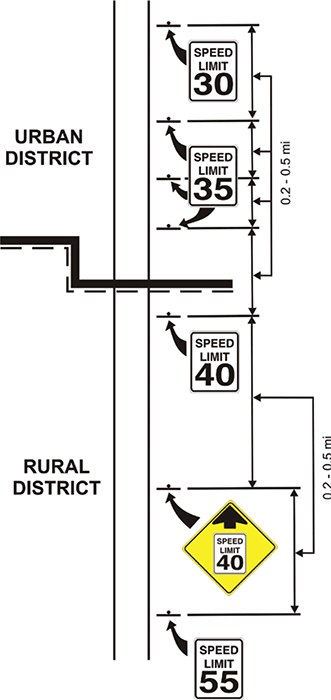
Transportation professionals should also consider special conditions, such as intersections, transition zones, work zones and school zones, bicycle and slow lanes, safe truck speeds, and possibly the need for variable speed limit systems when designing a road and determining speed limits. The FHWA report Guidelines for the Use of Variable Speed Limit Systems in Wet Weather provides details on how variable speed limits can be used during wet weather conditions for roads where the operating speed exceeds the design speed and stopping distance exceeds the available sight distance. The FHWA Office of Operations provides resources on Work Zone Speed Management from observing to managing speeds in work zones. ITE published a technical brief on Reduced School Area Speed Limits and the Pedestrian and Bicycle Information Center provides a school zones resource webpage.
The World Health Organization Speed Management: A Road Safety Manual for Decision-Makers and Practitioners has sections on Safe Systems and the Role of Speed. Additionally, the World Road Association Road Safety Manual, A Manual For Practitioners And Decision Makers On Implementing Safe System Infrastructure and the World Resources Institute report titled Sustainable and Safe: A Vision and Guidance for Zero Road Deaths provides information on how practitioners can apply the Safe Systems approach to fatalities and offers guidance on safe speed limits appropriate for the type of road, common crash types, safety of all road users, and how to effectively use safety data to inform speed management decisions.
The Insurance Institute for Highway Safety (IIHS) has conducted research on speed limits and provides a resource page on maximum and statutory speed limits in addition to resources provided on the ITE Speed Management for Safety resource hub. The IIHS speed webpage provides a table of maximum statutory speed limits on interstates in each state and provides history on maximum speed limits throughout the U.S. as useful background for understanding the nationwide shift of increasing speed limits on interstates.
Target Speed - the highest operating speed at which vehicles should ideally operate on a roadway in a specific context.
Operating Speed - the speeds at which vehicles are observed operating during free flow conditions. Free flow conditions mean that vehicles are unimpeded by other vehicles or by traffic control devices such as traffic signals.
Posted Speed - the maximum lawful speed for a particular location as displayed on a regulatory sign.
Speed Limit - the maximum lawful vehicle speed for a specific location. Design Speed - the selected speed used to determine the various geometric design features of the roadway.
Speed Distribution - the arrangement of speed values showing their observed frequency of occurrence. 85th Percentile Speed - the speed at or below which 85 percent of vehicles travel.
Mean Speed - the summation of the measured speeds of vehicles at a specific location divided by the number of vehicles measured.
Statutory Speed - the numerical speed limits established by state law that apply to various classes or categories of roads in the absence of posted speed limits.
Speed Zone - the speed limit established on the basis of an engineering study for particular section of road, for which a statutory speed limit is not appropriate.
Advisory Speed - a recommended speed where the need to reduce speed below the speed limit is recommended due to a specific road condition.
Speed-limit setting is one part of speed management. Target speed should reflect roadway function, surrounding context, expected users and conflicts, and human tolerance. Roadway design, operations, and the posted limit should then be aligned with that target speed.
The FHWA and ITE joint publication on Methods and Practices for Setting Speed Limits: An Informational Report is a comprehensive resource on speed limit basics for transportation professionals and provides the above industry definitions. The American Association of State Highway and Transportation Officials (AASHTO) publication A Policy on Geometric Design of Highways and Streets, 7th edition released in 2018, commonly referred to by the industry as the “green book,” has been adopted by the U.S. Department of Transportation as the design guide for federal roads, and state departments of transportation use it as the basis for state design manuals.
Design Speed vs. Operating Speed
Transportation professionals involved in speed management use two terms when discussing the design and operation of a given road—the design speed and the operating speed. Design speed is used explicitly for determining minimum values for road design, such as horizontal curve radius and sight distance. The “green book” outlines means and methods that transportation professionals can use to select the appropriate design speed based on road type. Ultimately, design speed is selected by an agency with statutory authority to set speeds based on many factors. The selected design speed is then used to determine the various geometric design features, most notably the horizontal and vertical curvature. Other geometric design features such as cross-section elements, lane widths, shoulder width, the presence of curbs, etc., are determined based on the road function and safety. People driving respond to roadway cues. Wide lanes, long sight distances, large turning radii, limited roadside activity, and uninterrupted progression may communicate a speed above the intended target. When operating speeds and target speeds differ, roadway design and operations should be reviewed rather than relying on the speed-limit sign alone. Ideally, the speed a motorist feels is safe is the same as the designs speed selected.
Operating speed is a term used to describe the observed speed of a group of vehicles traveling on a section of road. A group of vehicles typically do not travel at the exact same speed; thus a speed study usually creates a speed distribution. With an engineering approach, a speed study is done for a specific road segment during a certain period of time for a specific sample set to determine mean speed and the speed distribution. From the speed distribution of a speed study, the 85th percentile can be determined from the cumulative distribution plot projecting horizontally from the 85th percentile level to the intersection of the plot and reading the speed at the horizontal axis.
The 85th-percentile speed describes existing operating behavior. It does not independently establish what speed is appropriate for the context or compatible with a Safe System. An observed speed above the target speed should prompt review of the roadway, surrounding context, controls, and operations, rather than an automatic increase in the target or posted speed. There are many factors that may need to be considered when determining the safest operating speed. Ideally, the operating speed should be close to the speed limit.

Source: http://www.mikeontraffic.com/85th-percentile-speed-explained/
The current national MUTCD is the 11th Edition with Revision 1, dated December 2025. Applicable laws and current MUTCD provisions should be followed when establishing speed zones. An engineering study shall consider the roadway context. Other guidance includes considering operating speeds together with roadway environment, land use, pedestrian and bicycle activity, transit, access, roadway geometry, speed distribution, and crash history. The 85th-percentile speed is one input and should not, by itself, determine the target or posted speed. A Vision Zero approach encourages setting survivable speeds that are context appropriate and supported by the built environment.
https://safety.fhwa.dot.gov/speedmgt/
ref_mats/fhwasa12004/fhwasa12004.pdf, page 34
Target Speeds and Special Road Conditions
Another term that some transportation professionals are considering relative to speed management and context sensitive design approaches is the concept of target speeds. The concept of target speed is outlined as the highest speed at which vehicles should operate on a thoroughfare in a specific context, consistent with the level of multimodal activity generated by adjacent land uses, to provide both mobility for motor vehicles and a safe environment for pedestrians, bicyclists, and public transit users. Transportation professionals looking for more information on context sensitive design and speed can review the ITE recommended practice on Designing Walkable Urban Thoroughfares: A Context Sensitive Approach or the ITE Design Factors to Control Speed fact sheet.
Transportation professionals should also consider special conditions, such as intersections, transition zones, work zones and school zones, bicycle and slow lanes, safe truck speeds, and possibly the need for variable speed limit systems when designing a road and determining speed limits. The FHWA report Guidelines for the Use of Variable Speed Limit Systems in Wet Weather provides details on how variable speed limits can be used during wet weather conditions to increase stopping distance exceeds the available sight distance. The FHWA Office of Operations provides resources on Work Zone Speed Management from observing to managing speeds in work zones. ITE published a technical brief on Reduced School Area Speed Limits and the Pedestrian and Bicycle Information Center provides a school zones resource webpage.
Appropriate Speed Limits
The selection of the speed limit should provide safe mobility appropriate to the roadway function, surrounding context, expected conflicts, and needs of all road users. The operational efficiency is measured by travel time and the safety level of all users, measured by the incidence of crashes and resulting injuries and fatalities with consideration of the road function. Freeways and other high-level roads can accommodate higher speeds because of their design features that have grade separated interchanges and little or no interaction with non-motorized user or adjacent development. Road types with lower functional classes, such as minor arterials, collector, and local roads provide for a mix of road users, requiring that all road users are provided safe mobility.
Methods for Setting Speed Limits
The FHWA Speed Limit Setting Handbook describes approach for setting speed limits. Using a comprehensive engineering study, determine a speed limit that is safe for all road users and appropriate for the roadway’s function, design, surrounding land use, and operating conditions. The Safe System Approach provides the overarching safety framework: speed limits should help manage crash energy so that routine mistakes are less likely to result in death or serious injury.
The engineering study should consider six core factors:
- Roadway environment: roadside development, land use, driveway and access-point density, transit service, functional classification, traffic volumes, parking, and pedestrian and bicycle facilities and activity.
- Roadway characteristics: lane and shoulder widths, alignment, grade, multimodal infrastructure, median type, roadside conditions, intersections, lighting, and available sight distance.
- Geographic context: whether the roadway is in a rural, rural-town, suburban, urban, or urban-core context, together with its function and expected multimodal activity, and network connectivity.
- Crash experience: reported crashes over at least a 12-month period, including crash types, severity, and the road users involved.
- Speed distribution: the pace, median or 50th-percentile speed, and 85th-percentile speed of free-flowing vehicles.
- Operating-speed trends: previous speed studies and changes in speeds.
These factors should be evaluated together using engineering judgment. No single measure should determine the speed limit. In particular, the 85th-percentile speed describes existing driver behavior but does not independently establish the speed that is appropriate for the roadway context or safe for all users. On urban and suburban arterials, and rural arterials serving as main streets through developed areas, the 85th-percentile speed should not be used without considering all six factors. For freeways, expressways, and rural highways outside urbanized conditions, the MUTCD’s within-5-mph guidance applies only after the other factors have been considered and found not to warrant a different speed and practical speed-management measures have been considered.
A target-speed policy can provide a starting point based on roadway context and function. Decision-support tools such as USLIMITS2 and the NCHRP Research Report 966 speed-limit-setting tool may be used to check or refine a recommendation, but their results should be evaluated against the complete engineering study, the target speed, and local roadway conditions.
When operating speeds are substantially higher than the appropriate target speed, changing the posted limit alone may not achieve the desired result. The speed-limit recommendation should be paired with roadway design, access-management, operational, or other speed-management measures needed to make the target speed credible and achievable. The study findings, decision process, extent of the speed zone, and supporting measures should be documented and evaluated after implementation.
Featured Safe System Implementation Tool
NCHRP Research Report 1181, Tool 13: Enable Contextual Speed Limit Setting provides a practical resource for embedding roadway context and Safe System principles into speed-limit policies and decision-making processes. It complements the FHWA Speed Limit Setting Handbook by helping organizations move from individual speed studies toward consistent, context-sensitive speed-limit-setting practices.
Safe System Approach - The safe systems approach emphasizes that some degree of roadway user error will always occur, and that such errors should not result in a fatality or serious injury. With this approach, speed limits are set according to the crash types that are likely to occur, the impact forces that result, and the human body’s tolerance to withstand these forces. In the safe system approach, the primary criterion is the safety of all road users, including pedestrians and bicyclists that are more vulnerable to injury and death when hit by a vehicle. Consequently, this approach usually results in lower speed limits than those that would be determined by the engineering and expert system approaches. Tactics such as traffic calming, physical separation of roadway users, and treatments that enhance visibility of vulnerable users to give drivers greater reaction time are safe systems. A safe systems approach requires a holistic planning of the roads and interconnected factors provide for optimal safety. The safe systems approach is an ideal approach for many urban roads and to strengthen protection for vulnerable users. The World Health Organization Speed Management: A Road Safety Manual for Decision-Makers and Practitioners has sections on Safe Systems and the Role of Speed. Additionally, the World Road Association Road Safety Manual, A Manual For Practitioners And Decision Makers On Implementing Safe System Infrastructure and the World Resources Institute report titled Sustainable and Safe: A Vision and Guidance for Zero Road Deaths provides information on how practitioners can apply the Safe Systems approach to fatalities and offers guidance on safe speed limits appropriate for the type of road, common crash types, safety of all road users, and how to effectively use safety data to inform speed management decisions.

Source: https://safety.fhwa.dot.gov/speedmgt/
ref_mats/fhwasa16076/.
The NCHRP report Design Speed, Operating Speed and Posted Speed Practices is also a helpful resource for transportation professionals looking for additional information on the principles of speed. Transportation professionals can learn more on speed limits via the FHWA Speed Limit Basics resource. The FHWA Speed Concepts: An Informational Guide, published in 2009, is helpful for transportation professionals to determine the most appropriate speed limits. Additionally, numerous Transportation Research Board (TRB) studies are currently being conducted to provide guidance on all factors to be considered in setting speed limits. A 1998 TRB Special Report on Managing Speed can also be helpful in setting and enforcing speeds. The National Committee on Uniform Traffic Control Devices (NCUTCD) is currently re-examining language in the MUTCD related to speed limit setting practices and has conducted a practitioner survey on this topic. The AAA Foundation for Traffic Safety recently released a survey study of practitioners on the Review of Current Practices for Setting Posted Speed Limits in May of 2019. The study investigated the current practice of setting a speed limit through a review of the relevant documentation and by a survey of transportation professionals. The research brief also points to the challenges of current practices and future direction for speed limit posting.
The Insurance Institute for Highway Safety (IIHS) has conducted research on speed limits and provides a resource page on maximum and statutory speed limits in addition to resources provided on the ITE Speed Management for Safety resource hub. The IIHS speed webpage provides a table of maximum statutory speed limits on interstates in each state and provides history on maximum speed limits throughout the U.S. as useful background for understanding the nationwide shift of increasing speed limits on interstates.