By Kristen Brookshire, MCRP (M), Kristin Blank, Tamara Redmon (M), and Lauren Blackburn
An increasing number of cities and states are looking to bicycle transportation to achieve community goals related to health, safety, and the environment. Research over the past few decades has shown that bikeways improve safety and comfort and increase ridership for bicyclists.1 While practitioners focused on planning and designing for bicyclists are already familiar with the range of design options, they seek more guidance for selecting the type of design that will meet the needs of a broad spectrum of current, and potential, bicyclists.
Introducing a Bikeway Selection Process
The Federal Highway Administration (FHWA) supports a flexible approach to bicycle facility design and agencies can access a variety of design guidance from organizations like American Association of State Highway and Transportation Officials (AASHTO), the Institute of Transportation Engineers (ITE), and National Association of City Transportation Officials (NACTO). In 2015, FHWA released its Separated Bike Lane Planning and Design Guide. The new FHWA Bikeway Selection Guide complements these guides and fills a gap for transportation agencies by providing a resource that helps practitioners consider and make informed decisions about design that are grounded in the reality of complex user needs, fiscal constraints, and often limited rights-of-way.2
The Bikeway Selection Guide provides guidance for determining the appropriate level of bicyclist separation based on factors like roadway characteristics and traffic use (i.e., speed, volume, heavy vehicle mix), land use, and bicyclist profile (i.e., level of comfort or skill). The Guide also emphasizes that practitioners should consider bicyclists’ preferences and in doing so this will encourage bicycle ridership and use of facilities. This approach stands in contrast to decades of transportation planning and design focused on the mobility of motor vehicles.
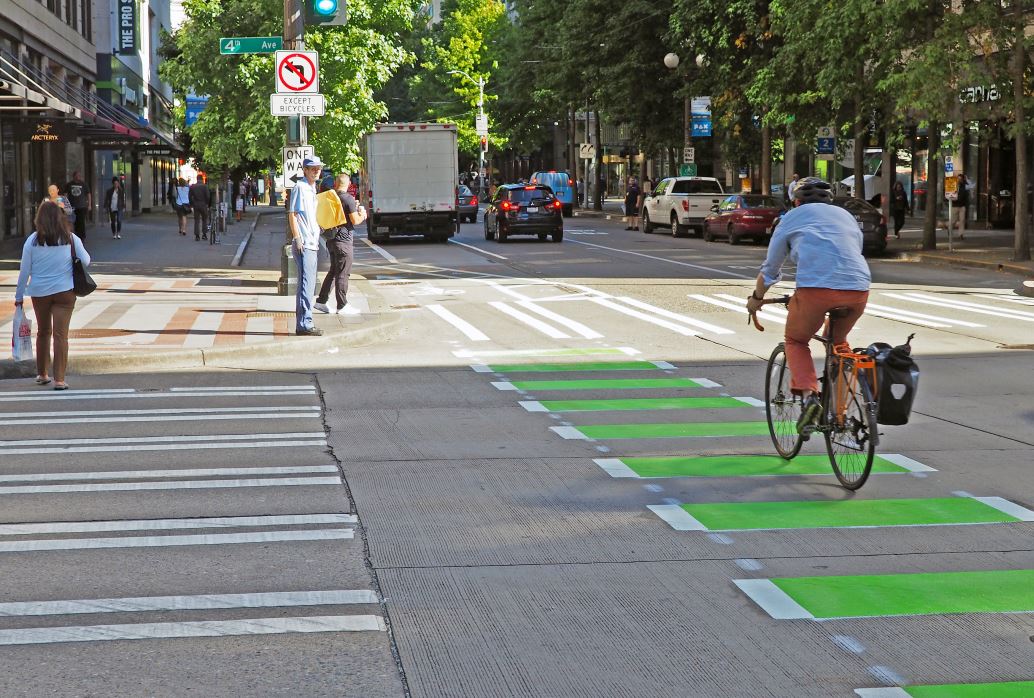
Example of a bikeway, or a facility intended for bicycle travel that designates space for bicyclists distinct from motor vehicle traffic.
A Brief History of Planning for Bicyclists
Bikeways provide a way for communities to meet the demand for livable and accessible places while working toward achieving community goals related to health and mobility, among others. In fact, bicyclists were heavily involved in the Good Roads Movement, which included advocacy for well-connected, paved streets in the late 1800s and early 1900s. Over time, due to a variety of factors, roadway design and construction became increasingly focused on mobility for motorists; however, with the energy crises of the 1970s, government agencies and the public had growing interest in bicycling for transportation. This interest is reflected in the first AASHTO Bicycle Guide, which was published in 1974 by the Standing Committee on Engineering Operations. The 1974 guide included warrants for “protected” and “unprotected” bicycle lanes and a variety of intersec-tion treatments designed to minimize conflicts between bicyclists, pedestrians, and motorists. However, the bicycling advocates with the loudest voices were the ones insisting that bicyclists operate like other drivers using a shared lane and the 1981 AASHTO Bicycle Guide mirrored this view—bike lane warrants were dropped and protected bicycle lanes were prohibited. Bicyclists who were more experienced and can ride at faster speeds for longer distances, also known as vehicular cyclists, continued to influence roadway design for much of the middle and late 20th century.3
Through the 1980s, the primary source of funding for surface transportation projects, including bikeways, was the gas tax. The Intermodal Surface Transportation Efficiency Act (ISTEA) of 1991 was the first major investment and recognition of the importance and need for active transportation facilities. ISTEA supported research and planning for bicycle and pedestrian transportation and mandated the National Bicycling and Walking Study, which set goals of increasing bicycling and walking trips while decreasing fatalities and injuries.
Despite the legislative and federal resources to promote bicycling, key design guidance continued to echo the desires of vehicular cyclists and their “right to the road” up until the fourth edition of AASHTO’s Guide for the Development of Bicycle Facilities (2012), which reintroduced bikeways with more physical separation, but still emphasized design for the confident bicyclist. FHWA’s Separated Bike Lane Planning and Design Guide (2015) outlines planning considerations for separated bike lanes and provides design options but recognized a need for a decision support tool to help practitioners select facilities. This is where the Bikeway Selection Guide comes into play.
Planning and Designing for All Ages and Abilities
Bikeway selection decisions are often part of a broader planning process that accounts for roadway and traffic characteristics of all modes. The community goals, transportation policies, and funding priorities are consulted and public engagement shapes the decision. Bikeway selection should also be informed by an understanding of the different types of bicyclists and consideration of the relation-ship between a bikeway and the bicycle network. Characteristics commonly used to classify design user profiles are comfort level, bicycling skill and experience, age, and trip purpose. Selecting the design user profile is often the first step in assessing a street’s compatibility for bicycling.
A study by researchers at Portland State University found that of adults who have stated an interest in bicycling, there are three types of potential and existing bicyclists: highly confident bicyclists, somewhat confident bicyclists, and interested but concerned bicyclists.4 Keeping in mind that comfort and stress are inversely related, agencies can consider these “types” of bicyclists as they evaluate different bikeway options and determine where higher quality facilities are needed most within their bicycle network. For example, high-comfort and low-stress networks, or, those networks with lower exposure to high motor vehicle speeds and volume, are appealing to the most people; low-comfort and high-stress networks are appealing to the least when comparing relatively similar options from Point A to B.

Bicyclist Design User Profiles.
As the Guide introduces each bikeway type and important considerations, it draws on research where available, and encourages Guide users to employ engineering judgement, design flexibility, documentation, and experimentation. The efficacy of each bikeway type is dependent upon factors like traffic volume, traffic speed, intersection design, and land use. Consideration of road context (i.e., rural, suburban, or urban settings), project type (i.e., new construction, reconstruction, or retrofit), and project purpose all help further refine the menu of bikeway options. For example, retrofit projects often have more constraints, so it may be more challenging to implement the preferred bikeway type.
Despite the expanding toolbox of bikeway facilities, intersections remain a challenging component of bikeway design, so while the mechanics of intersection design are not the focus of the Guide, the Guide summarizes the intersection performance characteristics for each bikeway type (i.e., safety, visibility, predictability, etc.) and explains the relationship between bicyclist comfort and exposure at different types of intersections. Bikeway design should be consistent and continuous from midblock locations through intersections. For example, it is not in keeping with best practices to design midblock separated bike lanes that transition to shared lanes at each inter-section as this breaks the continuity of the bikeway and exposes the bicyclist to motor vehicles. For more information on specific strategies at intersections, NACTO’s Don’t Give Up at the Intersection details different geometric designs and signal phasing strategies.5
Trade-Off Decisions in Practice
Bikeway selection is a context-sensitive decision that involves a planning- and engineering-based analytical process. Sometimes once a preferred bikeway type has been identified there are
real-world conditions like available right-of-way and budget that may require adjustments to preferred design values or eventually downgrading the facility to the next best bikeway type and/
or providing a parallel bikeway. Other factors involved in the discussion of trade-offs may include traffic volume and mix; parking and curbside activity; driveways and intersections; vulnerable populations; connectivity gaps; transit considerations; and more.
For instance, a conventional bike lane may yield high comfort when vehicle speeds and volumes are low, but the design also relies upon perfect driver and bicyclist behaviors to avoid crashes. A separated bike lane or a sidepath with protected intersections may be the most comfortable for bicyclists due to separation from motor vehicle traffic, but visibility may be reduced due to parking, which would then require vehicle parking restrictions.

Notes
- Chart assumes operating speeds are similar to posted speeds. If they differ, use operating speed rather than posted speed.
- Advisory bike lanes may be an option where traffic volume is <3K ADT.
- See Section 4.4 for a discussion of alternatives if the preferred bikeway type is not feasible.
This chart provides guidance for how motor vehicle volume and speed can be taken into consideration to determine a preferred bikeway type for urban, urban core, suburban, and rural town contexts. The Guide includes a separate chart for preferred shoulder widths on rural roadways. Section 4 of the Guide describes many other considerations that will arise in the bikeway selection process.
Technical, political, or financial realities may mean that not all roads can be retrofitted or designed with the appropriate bikeway. At locations where the preferred bikeway cannot be provided on the primary route and a parallel route is not feasible, agencies must recognize that bicycle activity may be suppressed, and the safety of bicyclists operating on this roadway segment may be reduced. When this occurs, other remedies such as the reduction of traffic speed or volume may be considered to help the community meet bicycling goals established in their adopted plans.
Uptake and Training
Since the release of the Guide, a webinar and series of workshop trainings have engaged practitioners across the United States. The Bikeway Selection Guide webinar is available to view on the Pedestrian and Bicycle Information website (www.pedbikeinfo. org/webinars) and includes discussion among Guide authors from the consulting firms Toole Design and VHB.
To encourage use of the Guide, FHWA hosted in-person workshops across the country and has adapted the format to include virtual learning in response to COVID-19. During the workshops, instructors emphasize the importance of assessing planned bikeway projects and conducting formal feasibility studies. The Guide introduces these as specific steps in the overall process, prior to moving into final bikeway selection and designing the bikeway, as opportunities to identify and evaluate the trade-offs between bikeway options. The instructors use visualizations to illustrate typical challenges to bikeway implementation—such as curbside traffic, driveway conflicts, on-street parking, and utility infrastructure. Participants work together to identify trade-offs and options for bikeways by examining local case studies.
For some agencies, these workshops provide a “nudge” when leadership has been reluctant to shift from a car-centric focus to one of multimodal inclusion, and for other agencies these workshops can reinforce their commitment to planning for bicycling while helping them work through the inherent tradeoffs.
For the Northeast Arkansas Regional Transportation Planning Commission, the shift to multimodal transportation planning has been slow and not universally supported according to MPO Director Cecelie Cochran. Ms. Cochran found that “through the FHWA Bikeway Selection Guide workshop, we were able to discover the incorporation of available options that are practical to our roadway system.” She added that her staff will use what they learned to identify and prioritize improvement projects throughout the region. In Ohio, workshop participants will apply what they learned as the Ohio Department of Transportation develops a statewide pedestrian and bicycle policy plan in 2019-2020.
By talking through these group exercises, workshop participants become more confident that they can clearly articulate the benefits and challenges of bikeway options to stakeholders and decision makers. This clarity promotes transparency and often leads to increased public support for bikeway implementation.
The full FHWA Bikeway Selection Guide is available at: https://safety.fhwa.dot.gov/ped_bike/tools_solve/docs/fhwasa18077.pdf. To learn more about technical assistance and training workshop opportunities, contact Tamara Redmon, +1-202-366-4077, tamara.redmon@dot.gov.
References
- Schultheiss, B., Sanders, R., Ludelman, B, Boudart, J., Blackburn, L., Brookshire, K., Nordback, K., Thomas, L., Van Veen, D., and Embry, M. “Literature Review: Resource Guide for Separating Bicyclists from Traffic.” FHWA-SA-18-030: Federal Highway Administration, Washington, DC, 2018.
- Schultheiss, B., Goodman, D., Blackburn, L., Wood, A., Reed, D., and Elbech, M. “Bikeway Selection Guide.” FHWA-SA-18-077: Federal Highway Administration, Washington, DC, 2019.
- Schultheiss, W. Sanders, R. Toole, J. “A Historical Perspective on the AASHTO Guide for the Development of Bicycle Facilities and the Impact of the Vehicular Cycling Movement.” Transportation Research Record: Journal of the Transportation Research Board, Volume 2672, Issue 13
- (2018): 38-49.
- Dill, D. and McNeil, N. “Revisiting the Four Types of Cyclists.” Transportation Research Record: Journal of the Transportation Research Board, Volume 2587, Issue 1 (2016): 90-99.
- National Association of City Transportation Officials. “Don’t Give Up At the Intersection: Designing All Ages and Abilities Bicycle Crossings.” May 2019.
Author Bios
 Kristen Brookshire, MCRP (M) is a research associate at the University of North Carolina Highway Safety Research Center (HSRC) where she develops research and guidance on planning and designing for the safety of people walking and bicycling. Examples include a primer for state highway transportation officials and university course materials for transportation instructors. She also provides technical assistance through the Pedestrian and Bicycle Information Center and the Walk Friendly Communities program.
 Kristin Blank is a communications manager at the University of North Carolina HSRC. To advance pedestrian and bicycling research efforts and initiatives, she focuses on strategic communications and outreach to translate ideas into practice. Kristin has experience with behavior change campaigns, multimedia communications, and data visualization.
 Tamara Redmon (M) is the Pedestrian and Bicycle Safety program manager in FHWA’s Office of Safety, where she has worked for 24 years. In her job she develops programs and resources to help reduce pedestrian and bicyclist crashes, fatalities, and injuries. Recent accomplishments include completion of a Searchable Pedestrian and Bicycle Safety Information Tool, development of a Guide for Scalable Risk Assessment Methods for Pedestrians and Bicyclists (and accompanying Areawide Exposure Tool), and completion of the guide mentioned in this article.
 Lauren Blackburn, AICP is a senior project manager with VHB. She has more than 17 years of experience in multimodal and long-range planning, and she is based in VHB’s Raleigh, NC, USA office. Lauren’s key areas of interest are in bicycle and pedestrian transportation, comprehensive planning, roadway safety, and community health. Prior to joining VHB, she worked for the North Carolina Department of Transportation as the director of the Division of Bicycle and Pedestrian Transportation. Previously, she was the planning manager for the Town of Davidson, NC. Lauren received her bachelor’s degree in Landscape Architecture from the University of Arkansas at Fayetteville and her master’s degree in Urban and Regional Planning from the University of Illinois at Urbana-Champaign. She is a member of the American Institute for Certified Planners (AICP), as well as the Transportation Research Board Standing Committee for Pedestrians.